FOCO Summer Fly Survey
Background
This report summarizes a small pilot study conducted during summer 2025 (July) to characterize the local Dipteran fauna around Colorado State University’s Fort Collins campus. The goal was to establish baseline knowledge of fly species composition for future decomposition ecology studies.
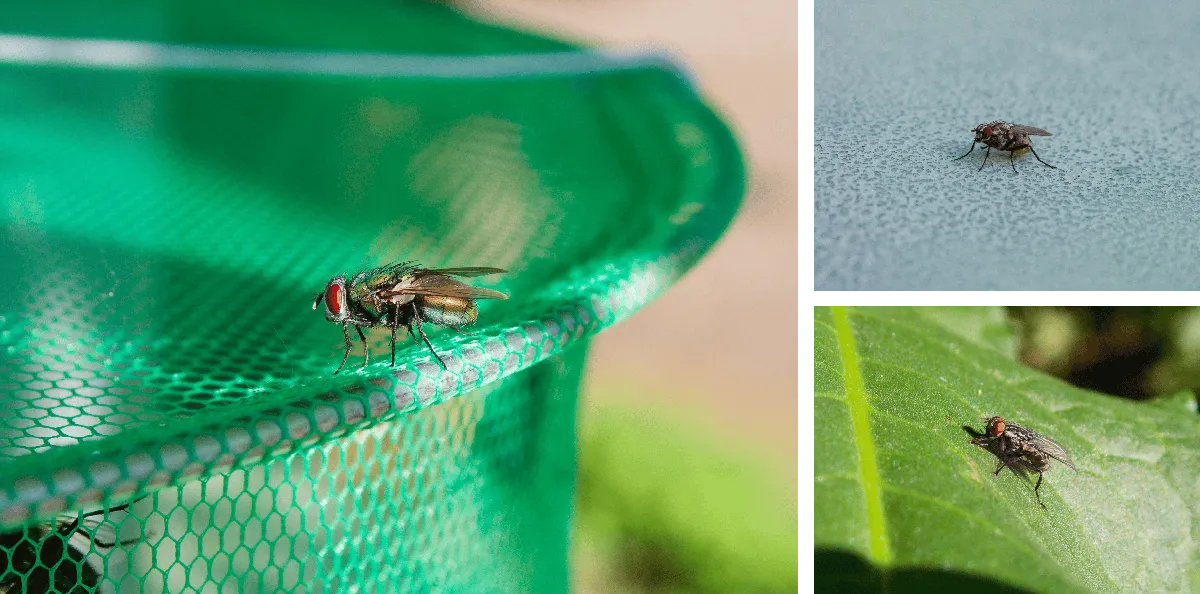
Representative specimens from the Fort Collins fly survey collection.
Methods
Collections were made using two trap types:
- Carton traps with commercial scented bait deployed near carrion (bird carcass)
- Net traps with commercial scented bait deployed near dumpsters
Traps were active for 2 days. All specimens were identified to species level based on morphological characteristics.
Results
The survey yielded surprisingly robust catches over just two days of trapping. While species diversity was moderate, the data provide valuable insights into summer fly assemblages at urban/campus sites in Fort Collins.
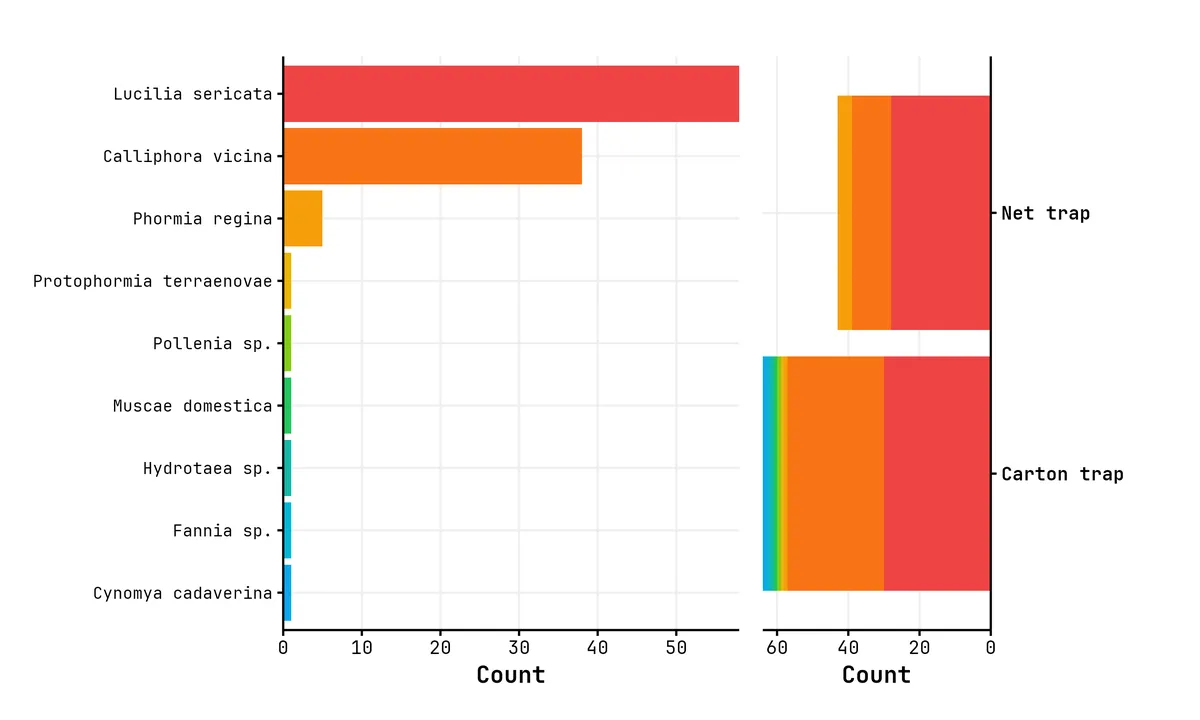
Species composition across trap locations and types.
Key Findings
Dominant Species:
- Lucilia sericata (green bottle fly) was the most abundant species overall, particularly dominant in both trap types
- Calliphora vicina (blue bottle fly) was common in both locations
- Phormia regina (black blow fly) present but less abundant
Location-Specific Patterns:
- Near carrion (bird): More diverse assemblage including Cynomya cadaverina, Fannia sp., Protophormia terraenovae, Hydrotaea sp., Pollenia sp., and Muscae domestica
- Near dumpsters: Dominated by Lucilia sericata with fewer species overall
Trap Efficacy:
- Both trap types successfully captured forensically relevant Calliphoridae
- Carton traps near carrion showed higher species diversity
- Net traps near dumpsters showed higher Lucilia abundance
Species Inventory
| Species | Location | Trap Type | Count |
|---|---|---|---|
| Lucilia sericata | Near carrion, Near dumpsters | Both | 72 |
| Calliphora vicina | Near carrion, Near dumpsters | Both | 37 |
| Phormia regina | Near carrion, Near dumpsters | Both | 5 |
| Cynomya cadaverina | Near carrion | Carton | 1 |
| Fannia sp. | Near carrion | Carton | 1 |
| Protophormia terraenovae | Near carrion | Carton | 1 |
| Hydrotaea sp. | Near carrion | Carton | 1 |
| Pollenia sp. | Near carrion | Carton | 1 |
| Muscae domestica | Near carrion | Carton | 1 |
Total specimens: 120 Total species: 9
Discussion
This preliminary survey demonstrates that commercial bait traps are effective for sampling forensically relevant Diptera in the Fort Collins area during summer months. The dominance of Lucilia sericata aligns with expectations for urban/suburban environments in this region.
Implications for future work:
- Summer collections will likely be dominated by Lucilia sericata and Calliphora vicina
- Carrion-baited traps capture greater species diversity than general attractants
- The presence of Cynomya cadaverina, Protophormia terraenovae, and other forensically relevant species confirms their local occurrence
(Obvious) Limitations:
- Short sampling period (2 days)
- Limited spatial coverage (2 locations)
- Single season (summer)
- No quantification of environmental variables
While species diversity was not exceptional, establishing which species will or will not appear during summer months at campus sites provides valuable baseline data for future decomposition studies requiring insect collection and identification.
Collections conducted July 2025 near Colorado State University Fort Collins campus.